
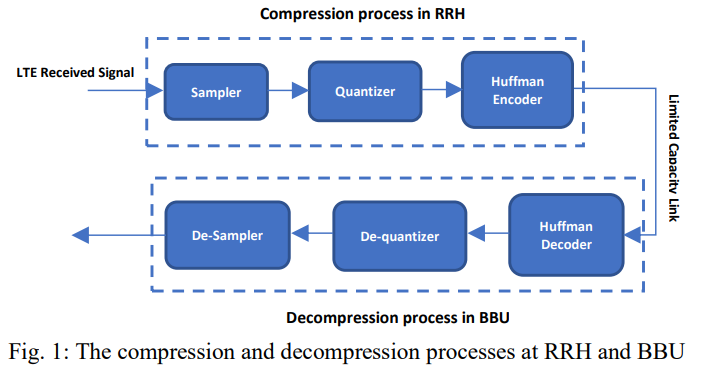
CPRI data compression using non-uniform quantized huffman technique in c-RAN
The long-term evolution (LTE) transports complex-baseband samples between the remote radio head and baseband processing unit. Common public radio interface (CPRI) protocol is used in practice and enables flexible radio head deployments and distributed antenna systems. Current wireless links (FSO and mmWave) have a few Gb/p transmissions which insufficient capacity are to support 20 MHz bandwidth LTE with multiple sectors. In this presented work, we propose a compression algorithm uses non-quantized Huffman. The proposed technique achieves 78% compression ratio while maintaining with EVM less
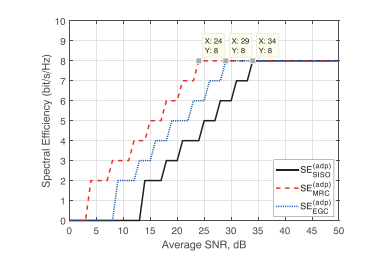
Spectral efficiency improvement with SISO and SIMO in M-QAM over millimeter-wave links
This paper proposes a spectral efficiency improvement technique for millimeter wave (mmWave) links. The proposed technique provides an efficient utilization of the mmWave link capacity. This technique is applied in three cases the single-input single-output (SISO), single-input multiple-output (SIMO) with the maximal ratio combining and with the equal gain combining. The M-ary quadrature amplitude modulation scheme is used in our work. The power series expansion is used for deriving closed-form expressions for bit error rate (BER) performances in all studied cases. The BER closed-form
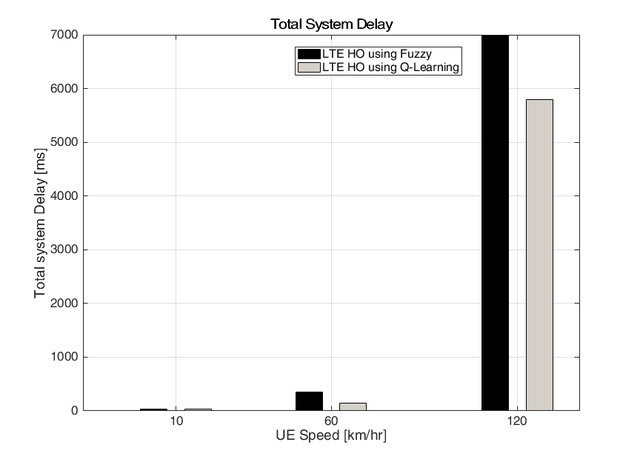
Type-2 Fuzzy Technique for LTE Handover Optimization Based on Cooperated Multi-Point
A seamless and fast handover from one cell to another is one of the main goals of long term evolution (LTE). Hence, the decision of handover is a critical part of the design process of handover. Then the selection of handover parameters must be in a careful and optimal way to have an efficient and successful handover. In this paper, a new optimized CoMP handover algorithm (CoMP HO) for LTE network based on type-2 fuzzy logic is presented. CoMP HO's were implemented by considering the cell-edge users and how to serve them without handover. It is shown via simulation that the proposed CoMP HO's

Fully balanced LED driving circuit for optogenetics stimulation
Implantable probes with built-in light emitters have a promising potential for a range of applications, in particular optogenetic neural stimulation. However, where soft encapsulation methods are used, lifetime will be a function of the quality of encapsulation and the driving mechanism. We have found that a balanced driving mechanism - whereby the integral voltage on encapsulated contacts, can significantly prolong lifetimes. As such, in this work, we have designed a driving circuit that drives current but ensures balanced electric fields with an error of less than 1%. The circuit has been
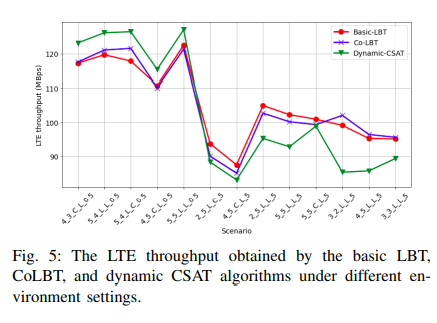
Machine Learning-based Module for Monitoring LTE/WiFi Coexistence Networks Dynamics
Long-Term Evolution (LTE) technology is expected to shift some of its transmissions into the unlicensed band to overcome the spectrum scarcity problem. Nevertheless, in order to effectively use the unlicensed spectrum, several challenges have to be addressed. The most important of which is how to coexist with the incumbent unlicensed WiFi networks. Incorporating the "intelligence"component into the network radios is foreseen to resolve the intrinsic network challenges, rather than conventional non-adaptive action plans. Specifically, an intelligent cognitive engine (CE) that continuously
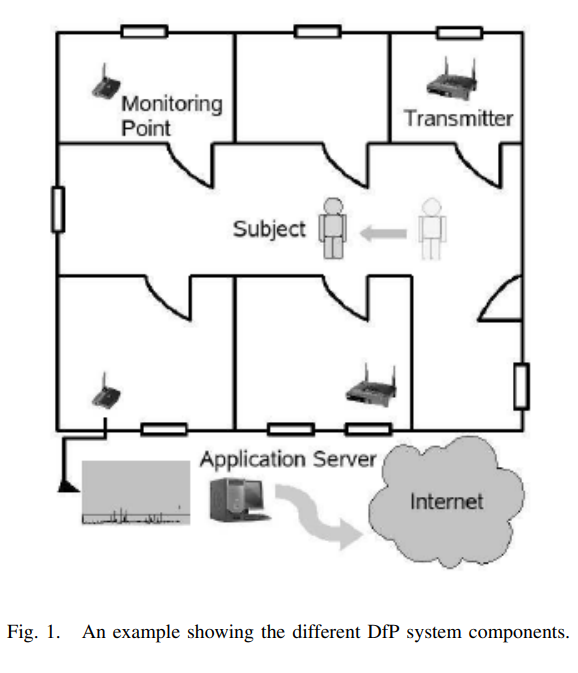
Smart devices for smart environments: Device-free passive detection in real environments
Device-free Passive (DfP) localization is a system envisioned to detect, track, and identify entities that do not carry any device, nor participate actively in the localization process. A DfP system allows using nominal WiFi equipment for intrusion detection, without using any extra hardware, adding smartness to any WiFi-enabled device. In this paper, we focus on the detection function of the DfP system in a real environment. We show that the performance of our previously developed algorithms for detection in a controlled environments, which achieved 100% recall and precision, degrades
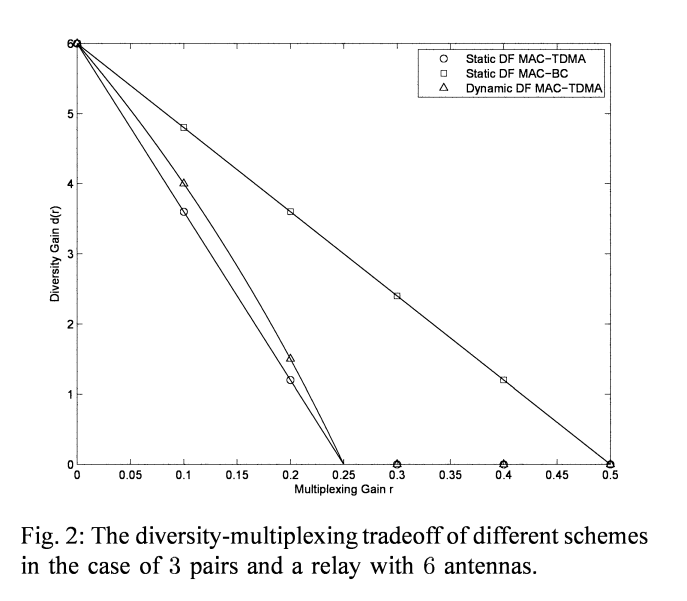
The MIMO wireless switch: Relaying can increase the multiplexing gain
This paper considers an interference network composed of K half-duplex single-antenna pairs of users who wish to establish bi-directional communication with the aid of a multiinput-multi-output (MIMO) half-duplex relay node. This channel is referred to as the "MIMO Wireless Switch" since, for the sake of simplicity, our model assumes no direct link between the two end nodes of each pair implying that all communication must go through the relay node (i.e., the MIMO switch). Assuming a delay-limited scenario, the fundamental limits in the high signal-to-noise ratio (SNR) regime is analyzed using
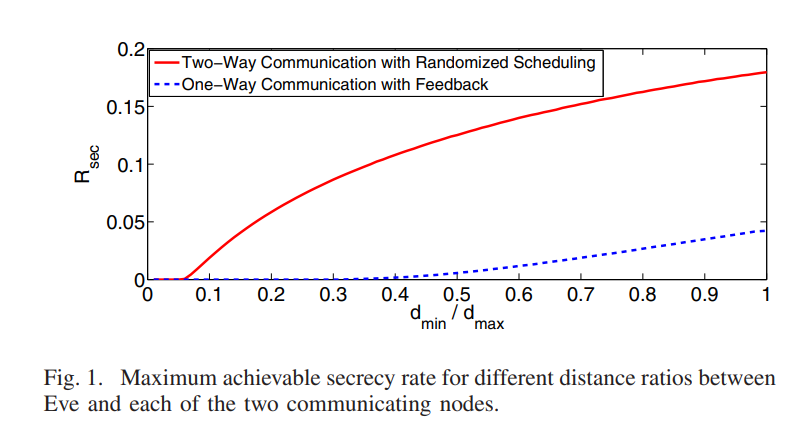
Randomization for security in half-duplex two-way Gaussian channels
This paper develops a new physical layer framework for secure two-way wireless communication in the presence of a passive eavesdropper, i.e., Eve. Our approach achieves perfect information theoretic secrecy via a novel randomized scheduling and power allocation scheme. The key idea is to allow Alice and. Bob to send symbols at random time instants. While Alice will be able to determine the symbols transmitted by Bob, Eve will suffer from ambiguity regarding the source of any particular symbol. This desirable ambiguity is enhanced, in our approach, by randomizing the transmit power level. Our
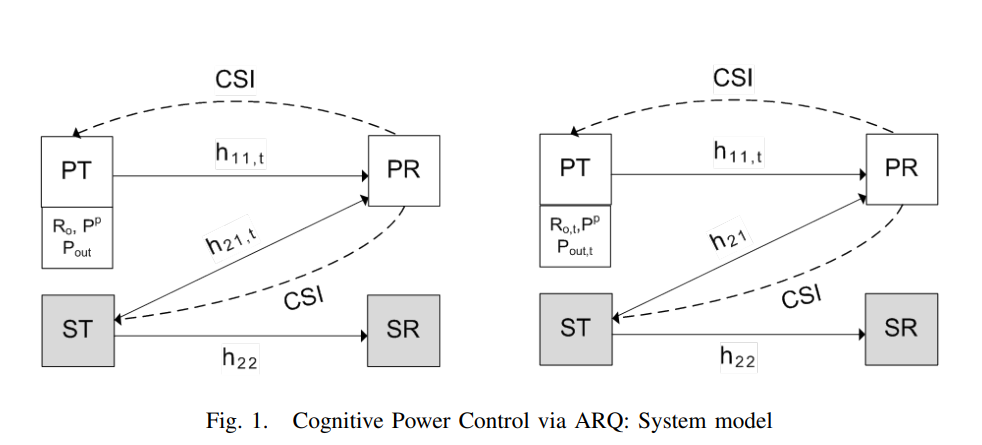
Throughput maximization over temporally correlated fading channels in cognitive radio networks
We consider a primary link and a secondary link, each composed of a transmitter and a receiver. The primary channel and the channel between the secondary transmitter and the primary receiver follow a first-order Markov model for channel variation over time. Under this assumption of temporal correlation and via exploiting the channel state information (CSI) feedback, we pose the cognitive power control problem as the maximization of secondary throughput subject to a constraint on the primary outage. To solve this problem, we assume that the primary transmitter sends with a constant-rate and
SANC: Source authentication using network coding
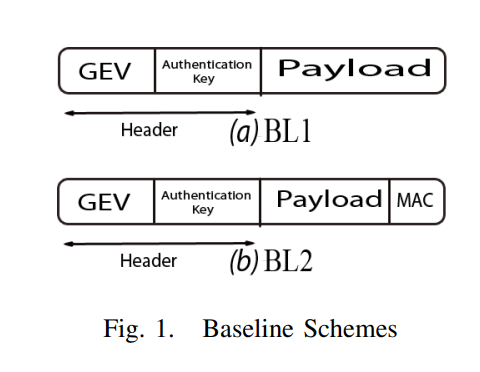
In this paper, we explore the security merits of network coding and potential trade-offs with the widely accepted throughput benefits, especially in multicast scenarios. In particular, we propose a novel Source Authentication using Network Coding (SANC) scheme that can either complement state-of-the-art application-layer authentication schemes proposed in the literature or be used as a stand-alone scheme in network coding-based networks. Towards this objective, we propose a general framework for embedding the authentication information within the network coding Global Encoding Vector. This is