
An information-theoretic model for knowledge sharing in opportunistic social networks
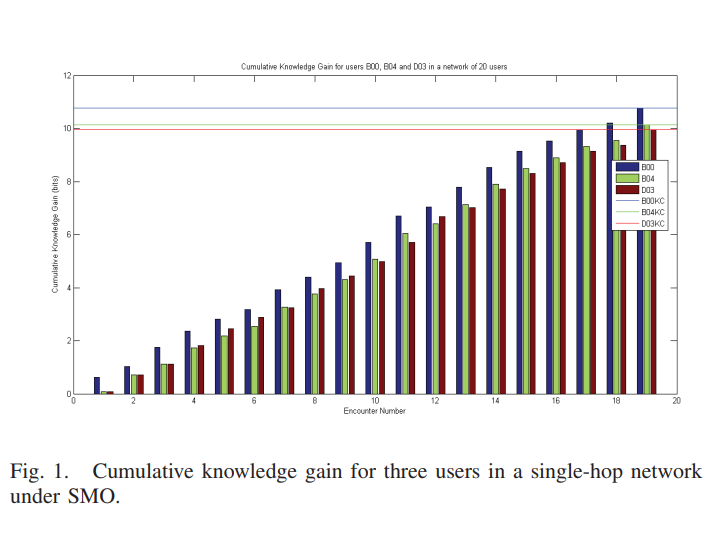
In this paper we establish fundamental limits on the performance of knowledge sharing in opportunistic social networks. In particular, we introduce a novel information-theoretic model to characterize the performance limits of knowledge sharing policies. Towards this objective, we first introduce the notions of knowledge gain and its upper bound, knowledge gain limit, per user. Second, we characterize these quantities for a number of network topologies and sharing policies. This work constitutes a first step towards defining and characterizing the performance limits and tradeoffs associated
Optimal cooperative cognitive relaying and spectrum access for an energy harvesting cognitive radio: Reinforcement learning approach
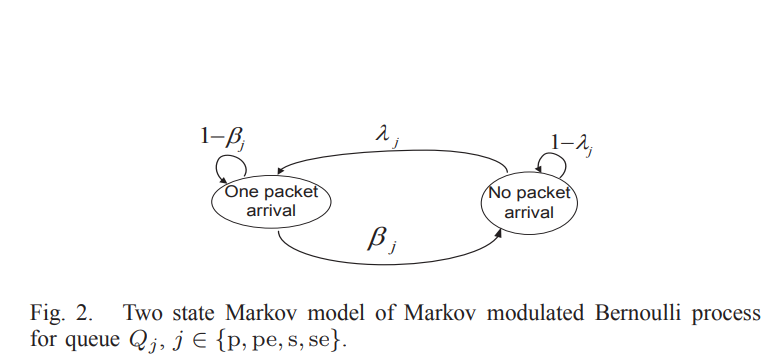
In this paper, we consider a cognitive setting under the context of cooperative communications, where the cognitive radio (CR) user is assumed to be a self-organized relay for the network. The CR user and the primary user (PU) are assumed to be energy harvesters. The CR user cooperatively relays some of the undelivered packets of the PU. Specifically, the CR user stores a fraction of the undelivered primary packets in a relaying queue (buffer). It manages the flow of the undelivered primary packets to its relaying queue using the appropriate actions over time slots. Moreover, it has the
On the synergistic benefits of alternating CSIT for X channel within a four-symbol channel extension
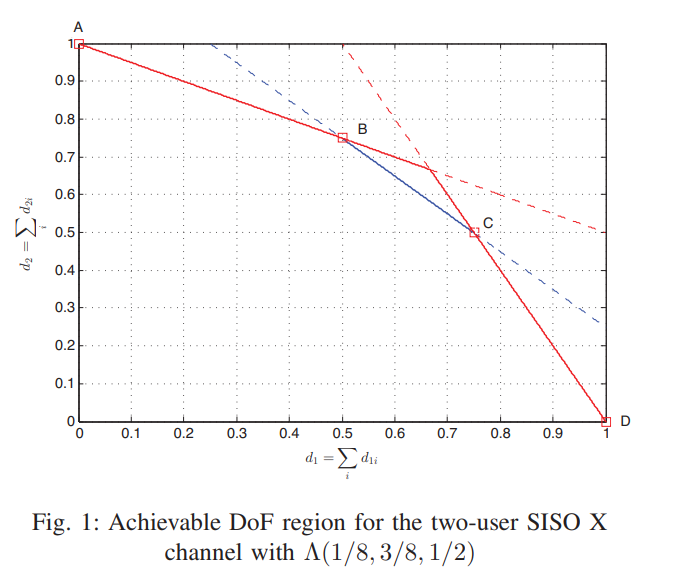
In this paper, we investigate the degrees of freedom (DoF) of the two-user single input single output (SISO) X channel with alternating channel state information at the transmitters (CSIT). Three cases are considered for the availability of CSIT; perfect, delayed and no-CSIT. Each state is associated with a fraction of time denoted by λP, λD and λN, respectively. We provide new results for the achievable DoF of the channel when the available CSIT alternates between these three cases under a certain distribution for Λ(λP, λD, λN). Specifically, we show that the two-user SISO X channel with
On optimal policies in full-duplex wireless powered communication networks
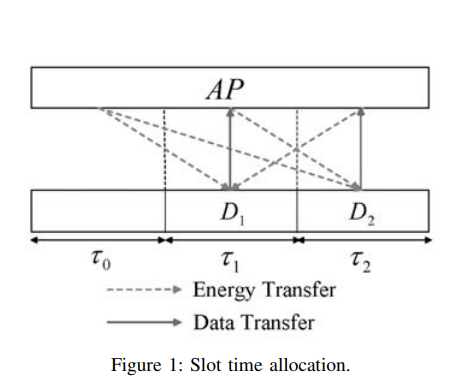
The optimal resource allocation scheme in a full-duplex Wireless Powered Communication Network (WPCN) composed of one Access Point (AP) and two wireless devices is analyzed and derived. AP operates in a full-duplex mode and is able to broadcast wireless energy signals in downlink and receive information data in uplink simultaneously. On the other hand, each wireless device is assumed to be equipped with Radio-Frequency (RF) energy harvesting circuitry which gathers the energy sent by AP and stores it in a finite capacity battery. The harvested energy is then used for performing uplink data

Effective capacity of delay-constrained cognitive radio links exploiting primary feedback
In this paper, we study the effective capacity (EC) of cognitive radio (CR) networks operating under statistical quality-of-service (QoS) constraints in an attempt to support real-time applications at the secondary users (SUs). In particular, we analyze the performance gains, in terms of EC and average transmitted power, attributed to leveraging the primary user (PU) feedback overheard at the SU, at no additional complexity or hardware cost. We characterize the EC performance improvement for the SU, in the presence of a feedback-based sensing scheme, under the signal-to-interference-plus-noise
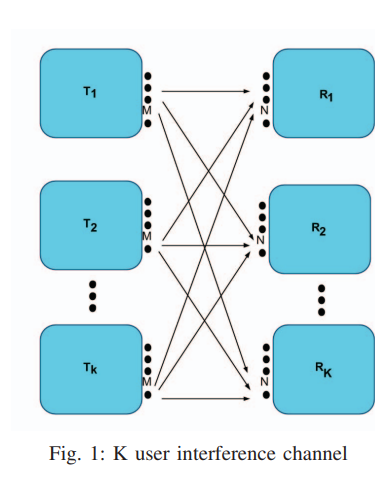
On the degrees of freedom region of the M × N Interference Channel
In this paper, the K-user MIMO interference channel is considered. The asymmetric DoF region for the channel is studied. The asymmetric DoF represent the set of all achievable DoF combinations {d1, d2,..., dK}. For the three user channel, two cases are presented, the first is when all transmitters and receivers have equal number of antennas M, the other is when each transmitter has M antennas, while each receiver has N antennas. For the K user channel, we extend our achievable scheme for the M × N case. It is assumed that the channel coefficients are constant and known to all transmitters and
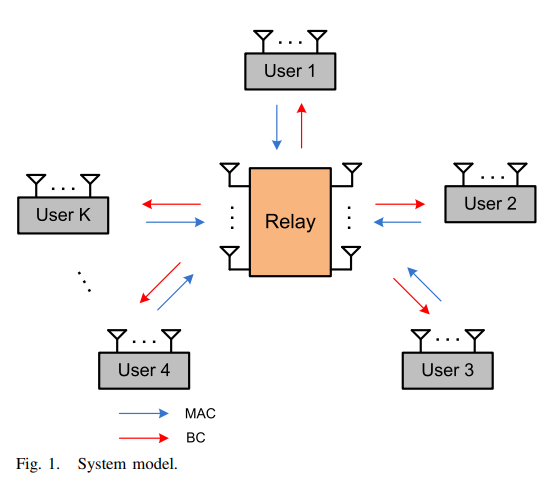
Degrees of Freedom for the MIMO Multi-Way Relay Channel with Common and Private Messages
In this paper, we study the general multiple input multiple output (MIMO) multi-way relay channel, i.e., MIMO Y channel, with common and private messages. In this channel, K users exchange messages through a common relay. Each user transmits a private message to each user in addition to a common message to all the other users. The i th user and the relay are equipped with Mi and N antennas, respectively. First, we derive the degrees of freedom (DoF) region of the symmetric three-user MIMO Y channel, where Mi = M and i ∈ {1,2,3}. Due to the symmetry of the network, we focus on the case where
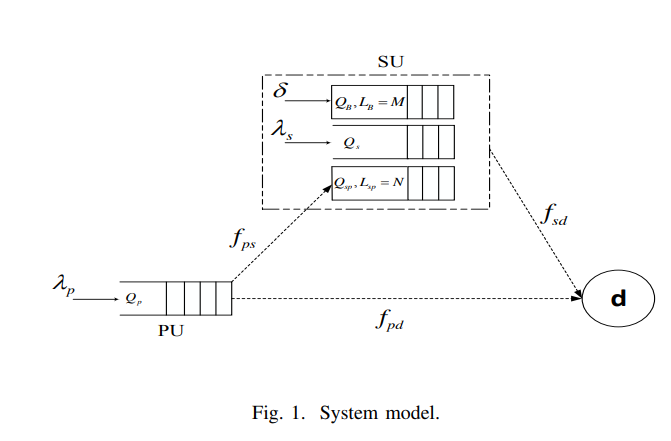
On the role of finite queues in cooperative cognitive radio networks with energy harvesting
This paper studies the problem of cooperative communications in cognitive radio networks where the secondary user is equipped with finite length relaying queue as well as finite length battery queue. The major hurdle towards fully characterizing the stable throughput region stems from the sheer complexity associated with solving the two-dimensional Markov Chain (MC) model for both finite queues. Motivated by this, we relax the problem and focus on two energy constrained systems, namely, finite battery queue with infinite relay queue and finite relay queue with infinite battery queue. We
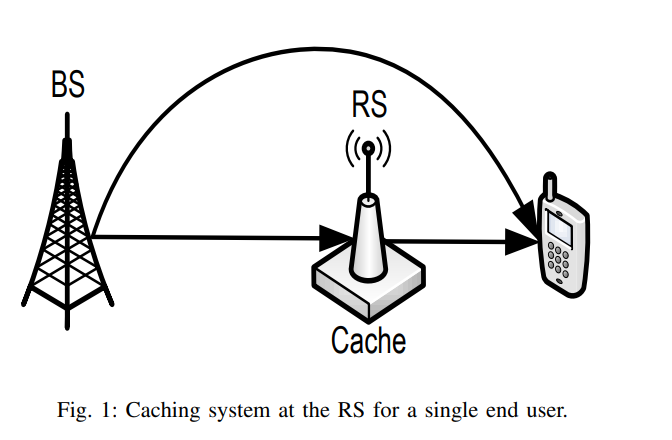
On Optimal Dynamic Caching in Relay Networks
We investigate dynamic content caching in relay networks where an intermediate relay station (RS) can adaptively cache data content based on their varying popularity. With the objective of minimizing the time average cost of content delivery, we formulate and study the problem of optimal RS cache allocation when the popularities of data content are unknown apriori to the network. While optimal dynamic cache control suffers the curse of dimensionality, we develop a fundamental lower bound on the achievable cost by any caching policy. Inspired by the structure of such lower bound, we develop a
Degrees of freedom region of device-relaying cellular network
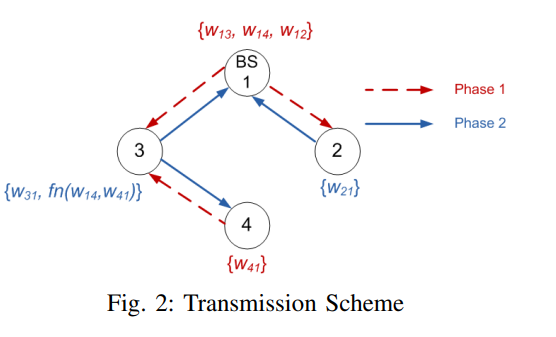
In this paper, we characterize the degrees of freedom (DoF) region of a MIMO device-relaying cellular network (DRCN) with three users and one base station (BS), where each user exchanges unicast messages with the BS. We assume that one of the users has no direct link to the BS, and hence, device-relaying is utilized to exchange data between this user and the BS, i.e., data is relayed via another user which has a direct link to the BS and a device to device (D2D) link to this user. We assume that each node operates in perfect full-duplex mode. Cut-set and genie-aided bounds are utilized to